Finding Purpose
The First Time I Went to Prison
A story about purpose, privilege, second chances, and what happens when your gifts meet the real world.
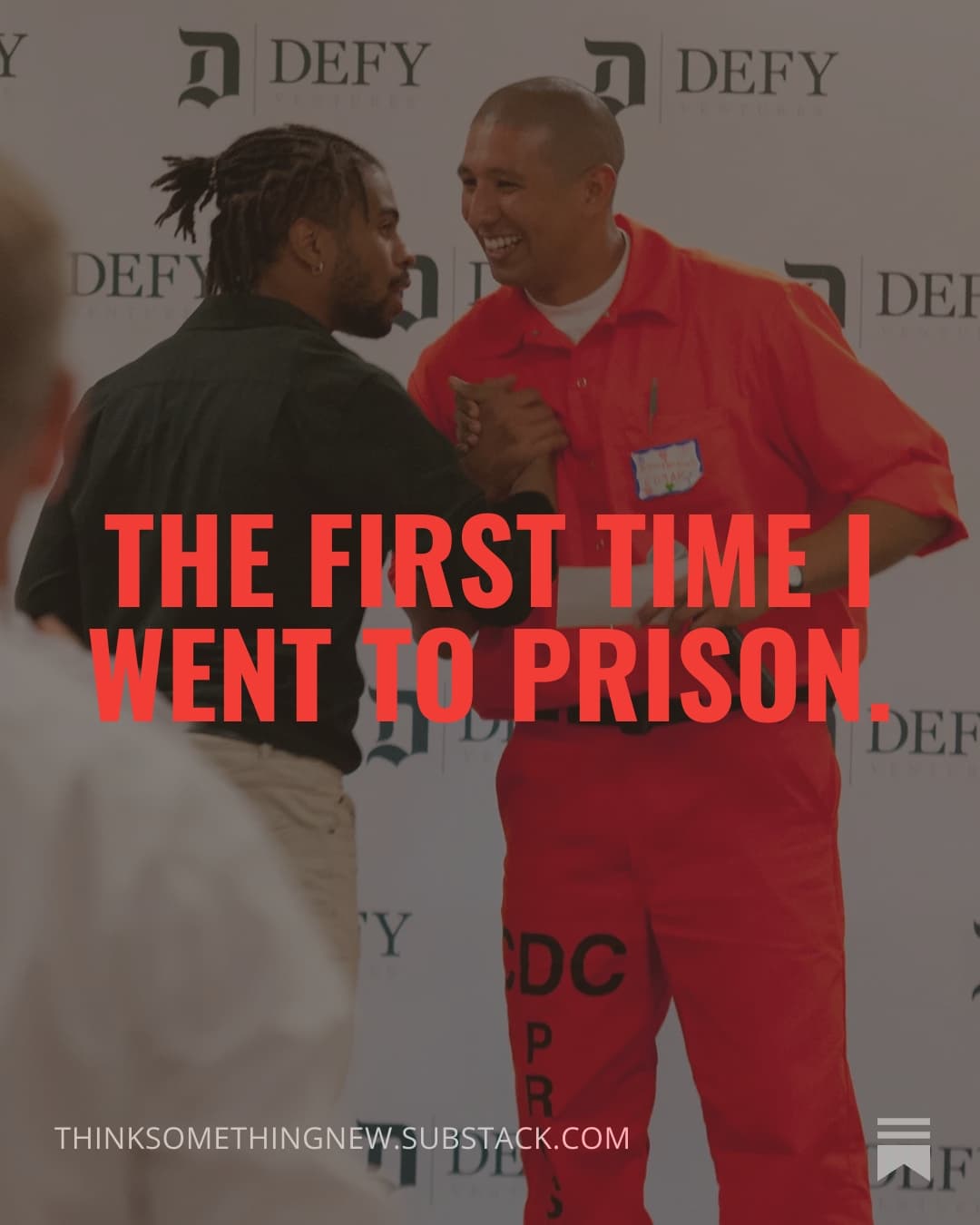
The first time I went to prison was October 17, 2017.
I was invited as part of a panel of “successful” entrepreneurs who were there to judge presentations from inmates who had spent months planning business ideas to launch after they got released.
The first place idea would win seed money and a head start on the next chapter of their lives.
It was like Shark Tank without commercial breaks.
And I felt wildly out of place.
The other panelists were multimillionaires with huge businesses and thousands of employees.
I had had some success as a film director but having a couple hundred million views didn’t feel comparable to having hundreds of millions of dollars.
But no one knew that.
So, I threw on the most dignified looking button down shirt I could find and tried my best to look like I belonged.
Some Context
The day wasn’t just for the prisoners.
It was a program designed to create understanding on both sides of the prison walls.
The organizers didn’t just want the prisoners to feel encouraged by a CEO telling them they had good ideas, they wanted the CEOs to feel empathy and understanding for what it’s like to be a human being with ideas that you don’t have the freedom to pursue.
So, before the pitches started, the organizers gathered everyone in the room together, shoulder to shoulder.
Man to man.
Cellmates and CEOs, all gathered on a line at one end of the room.
Then they started reading statements.
“Step forward if you grew up in an abusive household.”
“Step forward if you’ve ever watched a friend die.”
“Step forward if your parents were never married.”
“Step forward if you were kicked out of your home.”
Each statement was one gut punch after another.
One by one, the inmates who were bred in ecosystems of violence, stress, and survival moved to the far side of the room and one by one, the entrepreneurs stayed behind.
The exercise was doing exactly what it was designed to do: illustrate the distance between the people who could leave and the people who couldn’t.
The gulf between the line of businessmen and inmates wasn’t intelligence or good ideas, it was an uncomfortable and revealing look into the reality of luck, privilege, and poverty.
But there was one anomaly.
Me.
I found myself taking step after step with the inmates.
Leaving behind my fellow entrepreneurs as with every step I revealed that I’d been kicked out of my house, abused as a child, and dealt with more shit than I was planning on revealing during a business workshop.
I felt exposed.
Embarrassed.
Ashamed.
To the entrepreneurs I’d left behind, I wasn’t one of them anymore.
And to the inmates I now stood beside, I wasn’t one of them either.
I was something in between an orange prison jumpsuit and an oversized button down dress shirt.
And it reminded me of something.
Quick Story
Years earlier, I was sitting in the office of my college therapist.
I was already building my first business but I felt like I had to confess something.
I was terrified.
Terrified of something worse than failing.
I was terrified because somewhere underneath all the effort, I believed I was going to end up like the people I’d heard about who came from troubled backgrounds.
People who were destined to take more than they gave.
People who hurt others because they’d been hurt.
I’d grown up watching kids with good families from a distance and I didn’t think I could have what they had because they were built differently than me.
I was built the way my childhood made me feel — like a piece of shit who didn’t deserve any better.
Yes, I built things.
Started companies.
Directed films.
Took swings.
But underneath all of it was an anchor.
A belief that eventually it would all fall apart.
That I was only delaying the inevitable.
That people like me had ceilings, and I would find mine any day now.
My therapist knew better than to argue with statistics.
We both knew the majority of people caught up in patterns of struggle and failure come from less than ideal upbringings.
So instead, she said the only thing making me different was the choices I was making.
That’s why I should keep going.
I’d end up different because I wouldn’t stop trying to change the story.
I didn’t believe her.
I felt like she didn’t get it.
I thought she didn’t understand how broken I was or how destined for failure I’d be.
But now, standing in that prison years later, something started to click.
And it wasn’t the clean version.
It wasn’t “You choose your destiny!” or “Mindset is everything!” or any of the things that are easy to share on Instagram.
It was more uncomfortable than that.
Keep Trying
The men on the far side of that room with me weren’t in prison because they were weak or broken.
They were there because not only is it easy to give into your circumstances — it’s normal.
Life is hard.
And for some people it’s even harder.
It’s more natural to stay where you are than to keep grasping at half chances for something better.
They were there because the pressure around them had grown louder than the possibilities in front of them.
I wasn’t on the other side of those walls because I’d healed my past or figured something out.
I was there because I had kept moving.
Not from hope — more like compulsion.
I felt like I had to try, even if every fiber of my being believed it wouldn’t work.
Like if I took enough swings I could break the gravity of where I came from, even if I didn’t really believe that gravity could be broken.
And despite every statistic telling them otherwise — that’s what the inmates were there that day to do.
They were there to take a chance on their business.
On their ideas.
On their future.
There were dozens of business presentations and only one was going to win.
Even the idea that won would become one of millions of businesses entering a marketplace where, over time, most don’t survive.
But they were taking a chance.
They were trying.
Despite everything that said to stay where they were.
And that moved me.
By the time we got into the pitching competition I hung on to every word they said as they nervously took the stand to present their ideas.
I offered loving but rigorous feedback where I could, encouraged where it was deserved, and saw the passion in every man’s eye who decided to take a chance.
I don’t even remember half of the business ideas.
For me, it was less about the quality of the idea and more about the conviction of the attempt.
Even after we found our winner, I just remember what it felt like to want it for all of them and more than anything, to hope that they’d all keep trying.

So, the first time I went to prison was a very confusing experience.
When I got there, I wasn’t sure if I belonged with the rest of the entrepreneurs.
And after the Step Forward exercise, I felt like part of me knew that even though I had stories like the prisoners, that’s not where I belonged either.
But at the end of the day, after hearing out dozens of business ideas and seeing the courage of the men taking the chance to change their lives — I knew I was exactly where I was meant to be:
Around people who were still trying.
The anchor is still there.
Some quiet part of me is still waiting for the floor to fall out, for the ceiling to arrive, for the moment when it all confirms what I was told I was.
I’ve built things I’m proud of.
I’ve stood on stages.
I’ve kept taking chances.
And I still sometimes feel like I’m wearing a button-down that doesn’t quite fit.
But I’ll keep trying.
Key takeaways
- Purpose often becomes clearer when your gifts are used in service of real people, not just personal achievement.
- Privilege, trauma, luck, and choice can all be true at the same time.
- Trying to change your story does not always feel inspiring. Sometimes it feels like taking another swing even when you don’t believe it will work.
- The quality of the idea matters, but so does the conviction of the attempt.
- Sometimes you find where you belong by being around people who are still trying.
Questions this insight opens
How do I find purpose through service?
Purpose often becomes clearer when you bring your gifts into rooms where they can be useful. Service helps turn abstract questions like “What should I do with my life?” into more grounded questions like “Who can I help with what I already have?”
Can your past limit your future?
Your past can shape your nervous system, beliefs, opportunities, and sense of what feels possible. But it does not have to be the only author of your future. Change often begins with repeated choices that slowly create evidence for a different story.
What does it mean to change your story?
Changing your story means acting in ways that challenge the identity your past gave you. It does not mean pretending the past did not happen. It means refusing to let it be the only thing that defines what happens next.
Why does trying matter?
Trying matters because it creates movement where resignation would create stagnation. Even when the outcome is uncertain, trying is a refusal to let circumstance have the final word.
How can coaching help with purpose and identity?
Coaching can help you understand the story you’ve been living inside, clarify what you want to build next, and take practical steps that create evidence for a new identity. For creative leaders, founders, and high-achievers, this often means integrating ambition with service, meaning, and truth.
If this insight named something you’re navigating in your own life or leadership, explore coaching with Imari.
Continue
Get useful monthly insights.
Sign up for always entertaining life stories from a real life protagonist.




Read next:
If this insight resonated, continue with The Cost of Pessimism — If this insight is about purpose through service and second chances, this next one is about why hope is not naïve when action depends on it..